|
(The synopsis of this is on YouTube: The second half of the Pesher of Christ Intro . From original essay Twelve Disciples Revealed © 2009-2016 by Dylan Stephens Each Disciple discussed using each from the painting of the Last Supper by DaVinci with relevant references from the Gospels and Acts. |
| Gospel of Matthew - Author: Matthew (written last) (Matthias, High Priest 43AD, a Sadducee, younger brother of Theophilus (dedicated in Luke and Acts)) Published 48AD (The white robed priest on white horse) | ||||||
|---|---|---|---|---|---|---|
| Matt 10:2-4 "Now the names of the disciples are: the first, | 1.Simon (who is called Peter) and | 2.Andrew, his brother; | 3.James, son of Zebedee and | 4.John, his brother; | ||
| 5.Philip and | 6.Bartholomew; | 7.Thomas and | 8.Matthew the tax collector; | |||
| 9.James son of Alphaeus, and | 10.Lebbaeus, whose surname was Thaddaeus; | 11.Simon the Canaanite and | 12.Judas Iscariot, who betrayed him." | |||
| Gospel of Mark - Author: Peter, scribed by Mark (not John Mark) (written second) Published 48AD (The red priest on red horse) (Fragments Of Papias, Eccl Hist 3.39.15 "Mark, having become the interpreter of Peter, wrote down accurately, though not indeed in order, whatsoever he remembered of the things said or done by Christ.") | ||||||
| Mark 3:16-19 | 1."And Simon (to whom he gave the name Peter); | 3.James, son of Zebedee and | 4.his brother John (to them he gave the name Boanerges, which means Sons of Thunder); And | 2.Andrew, and | ||
| 5.Philip, and | 6.Bartholomew, and | 8.Matthew, and | 7.Thomas, and | |||
| 9.James son of Alphaeus, and | 10.Thaddaeus, and | 11.Simon the Canaanite and | 12.Judas Iscariot, who betrayed him." | |||
| Gospel of Luke - Author: Jesus, scribed by Luke (written third) Published 48AD (The black robed priest on black horse) Dedicated to Theophilus, son of Ananus, High Priest 37- 41AD | ||||||
| Luke 6:14-16 | 1."Simon (whom he named Peter), | 2.his brother Andrew, | 3.James and | 4.John, | ||
| 5.Philip and | 6.Bartholomew, | 8.Matthew and | 7.Thomas, | |||
| 9.James son of Alphaeus and | 11.Simon who was called the Zealot, | 10.Judas of James (Thaddaeus), and | 12.Judas Iscariot, who became a traitor" | |||
| Acts of the Apostles - Author: Luke | ||||||
| Acts 1:13 "Those present were | 1.Peter, | 4.John, | 3.James and | 2.Andrew; | ||
| 5.Philip and | 7.Thomas, | 6.Bartholomew and | 8.Matthew; | |||
| 9.James son of Alphaeus and | 11.Simon the Zealot, and | 10.Judas son of James (Thaddaeus). | 12.Matthias* was added to the eleven apostles. | |||
| In the replacement for Judas Iscariot, the clue lies with whom they passed up namely |
|---|
| Acts 1:23,26:
Joseph called Barsabbas (also known as Justus). There is the "bar" meaning son of "Sabbas". The tip off is the title Justus which is used for James the Just. In Acts 15:22 it says "They sent Judas called Barsabbas, and Silas". "Matthias is Barnabas" (Clementines R.1.60); full name Joseph Barnabas Acts 4:36-37), Barnabas is a corrupted son of Sabbas (Barsabas): All of Jesus' brothers and Jesus himself are last name Barsabbas because their father Joseph is Joseph Sabbas. Matthew 13:55 "Is not this the carpenter's son? Is not his mother called Mary? And are not his brothers James and Joseph and Simon and Judas?" (actually Simon is the youngest) So Jesus' younger brother James was passed over for his younger brother. |
| Gospel of John - Author: Jesus and Simon Magus, scribed by John Mark (written first, but revised later) Published 48AD (The green robed priest on pale horse) Its disciple list must be taken from references: | ||||||
|---|---|---|---|---|---|---|
| John 1:35,36 "The next day again John was standing with two of his disciples and he looked at Jesus as he walked, and said, 'Behold, the Lamb of God!'" | John the Baptist (not a disciple) 2. Andrew & one unnamed (Philip?) | |||||
| John 1:40-46 "And one of the two who heard John speak and followed him was | 2. Andrew, Simon Peter's brother" | |||||
| "Andrew first finds his own brother | 1. Simon" (Peter) | |||||
| ... "When Jesus saw him, he said, 'You are | 1. Simon son of Jona, thou shall be called Cephas, which is interpreted a rock: 'Petros.'"(Peter) | |||||
| "The day following Jesus would go forth into Galilee and finds | 5. Philip". | |||||
| "Philip finds | Nathanael." | |||||
| John 3:1 "There was a man of the Pharisees named | Nicodemus, ruler of the Jews" (Therapeuts of Egypt) | |||||
| John 3:4-9 Nicodemus said to him, "How can a man be born when he is old? Can he enter a second time into his mother's womb and be born? ... Nicodemus said to him, "How can this be?" | Nicodemus | |||||
| John 6:5-7... Jesus said to Philip, "How are we to buy bread, so that these people may eat? ... Philip answered him," | 5. Philip. | |||||
| John 6:8 One of his disciples, Andrew, Simon Peter's brother, said to him, | 2. Andrew, Simon Peter's brother | |||||
| John 6:68 Simon Peter answered him, "Lord, to whom shall we go? | 1. Simon Peter | |||||
| John 6:70,71 Jesus answered them, "Did I not choose you, the twelve, and one of you is a devil?" He spoke of Judas Iscariot, Simon's son, for he, one of the twelve, was to betray him. | 12. Judas the son of Simon | |||||
| John 6:71, Simon's son, for he, one of the twelve, was to betray him. | 11. Simon | |||||
| John 7:50,51 "Nicodemus said unto them, (he that came to Jesus by night, being one of them,) 'Does our law judge any man, before it hear him, and know what he does?'" | Nicodemus | |||||
| John 11:1 "Now a certain man was ill, Lazarus of Bethany, the village of Mary and her sister Martha. | Lazarus | |||||
| John 11:11-14... "Our friend Lazarus has fallen asleep, but I go to awake him out of sleep." Then Jesus told them plainly, "Lazarus is dead" | Lazarus | |||||
| John 11:16 Thomas, called the Twin, said to his fellow disciples, "Let us also go, that we may die with him." | 7. Thomas, called the Twin | |||||
| John 11:17 Now when Jesus came, he found that Lazarus had already been in the tomb four days | Lazarus | |||||
| John 11:43 When he had said this, he cried with a loud voice, "Lazarus, come out." | Lazarus | |||||
| John 12:1 Six days before the Passover, Jesus came to Bethany, where Lazarus was, whom Jesus had raised from the dead ... There they made him a supper; Martha served, and Lazarus was one of those at table with him. | Lazarus | |||||
| John 12:4,5 But Judas Iscariot, one of his disciples (he who was to betray him), said, "Why was this ointment not sold for three hundred denarii and given to the poor?" | 12. Judas Iscariot | |||||
| John 12:9,10 When the great crowd of the Jews learned that he was there, they came, not only on account of Jesus but also to see Lazarus, whom he had raised from the dead. So the chief priests planned to put Lazarus also to death, | Lazarus | |||||
| John 12:21 So these came to Philip, who was from Bethsaida in Galilee, and said to him, "Sir, we wish to see Jesus." | 5. Philip | |||||
| John 12:22 Philip went and told Andrew; Andrew went with Philip and they told Jesus. | 2. Andrew | |||||
| John 13:2 "And during supper, when the devil had already put it into the heart of Judas Iscariot, Simon's son, to betray him" | 12. Judas Iscariot, Simon's son | |||||
| John 13:2 "And during supper, when the devil had already put it into the heart of Judas Iscariot, Simon's son, to betray him" | 11.Simon | |||||
| John 13:6-9 He came to Simon Peter; and Peter said to him, "Lord, do you wash my feet?" ... Peter said to him, "You shall never wash my feet." ... Simon Peter said to him, | 1. Simon Peter | |||||
| John 13:23 "Now there was leaning on Jesus' breast | 6. "one of his disciples whom Jesus loved" | |||||
| John 13:24 so Simon Peter beckoned to him | 1. Simon Peter | |||||
| John 13:26 So when he had dipped the morsel, he gave it to | 12. Judas Iscariot, the son of Simon | |||||
| John 13:26... son of | 11. Simon | |||||
| John 14:8.9 Philip said to him, "Lord, show us the Father, and we shall be satisfied. Jesus said to him, "Have I been with you so long, and yet you do not know me, Philip? | 5. Philip | |||||
| John 14:22 Judas, not Iscariot said to him, "Lord, how is it that you will manifest yourself to us, and not to the world?" | Judas, not Iscariot | |||||
| John 18:2-5 Now Judas, who betrayed him, also knew the place ... So Judas, procuring a band of soldiers ... Judas, who betrayed him, was standing with them | 12. Judas | |||||
| John 18:10,11 Then Simon Peter, having a sword, drew it and struck the high priest's slave and cut off his right ear. The slave's name was Malchus. Jesus said to Peter, "Put your sword into its sheath; | 1. Peter | |||||
| John 18:15-18 Simon Peter followed Jesus, and so did another disciple. As this disciple was known to the high priest, he entered the court of the high priest along with Jesus, ... Peter also was with them, standing and warming himself. | 1.Simon Peter | |||||
| John 18;25-27 Now Simon Peter was standing and warming himself. They said to him, "Are not you also one of his disciples?" He denied it and said, "I am not" ... Peter again denied it; and at once the cock crowed. | 1.Simon Peter | |||||
| John 18;40 They cried out again, "Not this man, but Barabbas!" Now Barabbas was a robber. | Barabbas | |||||
| John 19:18 There they crucified him, and with him two others, one on either side, and Jesus between them. | Two others crucified with Jesus | |||||
| John 19:26 When Jesus saw his mother, and the disciple whom he loved standing near, he said to his mother, "Woman, behold, your son!" | 6. "the disciple whom Jesus loved" | |||||
| John 19:38 After this Joseph of Arimathea, who was a disciple of Jesus, but secretly, for fear of the Jews, asked Pilate that he might take away the body of Jesus | Joseph of Arimathea | |||||
| John 19:39 And Nicodemus also came -- who came unto Jesus by night at the first -- bearing a mixture of myrrh and aloes, as it were, a hundred pounds."" | Nicodemus | |||||
| John 20:2 "She (Mary Magdalene) ran, therefore, and came unto Simon Peter, and unto the other disciple whom Jesus loved, and said to them, 'They took away the Lord out of the tomb, and we have not known where they laid him.'" | 1. Simon Peter 6. "the disciple that Jesus loved" | |||||
| John 20:24-28 Thomas, one of the twelve called the Twin was not with them when Jesus came ... Thomas answered him, "My Lord and my God!"" | 7. Thomas called the Twin | |||||
| Believed to have been added, yes, but added in its revision under Matthew in 48AD and published last | ||||||
| John 21:2 "After this Jesus revealed himself again to the disciples by the Sea of Tiberias; and he revealed himself in this way.There were together | Simon Peter | |||||
| and | 7. Thomas who is called the Twin" | |||||
| , and Nathanael from Cana of Galilee | Nathanael | |||||
| , and the sons of Zebedee | 3.&4.sons of Zebedee (James & John) | |||||
| ; and two others of his disciples." | 5. Philip? & 2. Andrew? | |||||
| John 21:7 "That disciple, therefore, whom Jesus loved, said to Peter, 'It is the Lord!'" | 6. "the disciple whom Jesus loved" | |||||
| Names unique to John in order of appearance | |
|---|---|
| Nathanael: James son of Alphaeus | |
| Nicodemus: Thaddeus | |
| Lazarus: Simon (in Luke 16:20-25 merely as a parable as a pun comparing a rich man (High Priest Ananus the father of five high priests (see priest list)) to the beggar Lazarus (Simon) being raised from the dead} | |
| "the disciple whom Jesus loved": Bartholomew | |
| "Judas not Iscariot": Thaddeus having taken Iscariot's vacated seat | |
| Names contained in the Four Gospels not assigned | |
|---|---|
| "Two others crucified with Jesus": 1. Mark 15:21 "And they compel one Simon a Cyrenian (Simon Magus), who passed by, coming out of the country, the father of Alexander (Thaddeus) and Rufus (Thomas), to bear his cross." & 2. Matthew 27:5 "And he (Judas) cast down the pieces of silver in the temple, and departed, and went and hanged himself." | |
| Joseph of Arimathea Luke 23:50-52 "a member of the council, a good and righteous man": Jesus' brother James the Just, so not a disciple | |
| Matthew | Mark | Luke | Acts | John | |
|---|---|---|---|---|---|
| 01 | (1) the first, Simon (who is called Peter) | (1) Simon (to whom he gave the name Peter) | (1) Simon (whom he named Peter) | Those present were (1) Peter | (2) Simon son of Jona, thou shall be called Cephas, which is interpreted a rock: Petros (Peter)." |
| 02 | (2) Andrew his brother, | (4) Andrew | (4) Andrew | (2) his brother Andrew | And one of the two who heard John speak and followed him was (1) Andrew, Simon Peter's brother |
| 03 | (3) James | (2) James, son of Zebedee | (3) James | (3) James | (10) the sons of Zebedee |
| 04 | (4) John, his brother | (3) his brother John | (4) John | (2) John | (11) the sons of Zebedee |
| 05 | (5) Philip | (5) Philip | (5) Philip | (5) Philip | The day following Jesus would go forth into Galilee and finds (3) Philip |
| 06 | (6) Bartholomew, | (6) Bartholomew | (6) Bartholomew | (7) Bartholomew | "Now there was leaning on Jesus' breast one of his disciples whom Jesus loved" (9) Bartholomew |
| 07 | (7) Thomas, and | (8) Thomas | (8) Thomas | (6) Thomas | (8) Thomas, one of the twelve called the Twin |
| 08 | (8) Matthew the tax collector | (7) Matthew | (7) Matthew | (8) Matthew | (not present) |
| 09 | (9) James the son of Alphaeus | (9) James the son of Alphaeus | (9) James the son of Alphaeus | (9) James the son of Alphaeus | (4) Nathanael |
| 10 | (10) Lebbaeus, whose surname was Thaddaeus | (10) Thaddaeus | (10) Judas of James | (10) Judas of James | (5) Nicodemus |
| 11 | (11) Simon the Canaanite | (11) Simon the Canaanite | (11) Simon who was called the Zealot | (11) Simon the Canaanite | (Judas of) (7) Simon (Lazarus) |
| 12 | (12) Judas Iscariot, who betrayed him. | (12) Judas Iscariot, who betrayed him | (12) Judas Iscariot, who became a traitor | The lot fell to (12) Matthias (Barnabas) | (6) Judas Iscariot |
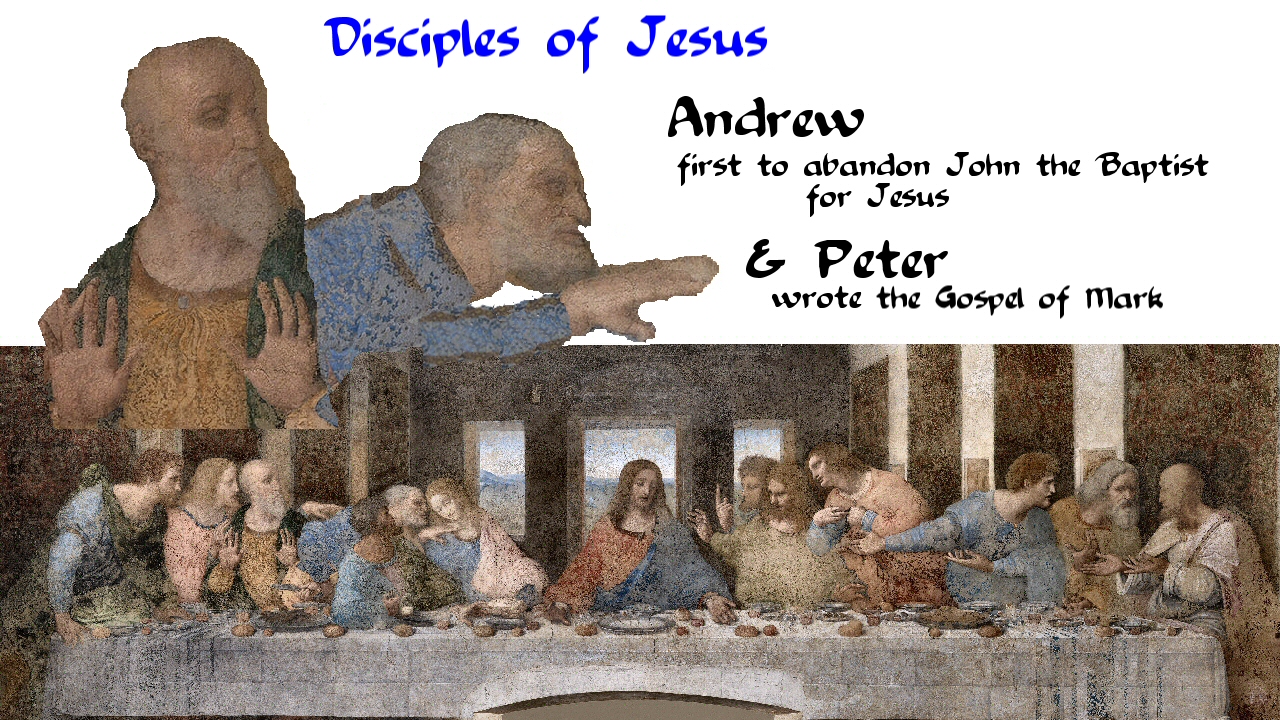
(1) Peter's name was Simon, having been changed by Jesus to Peter (Petros:rock) so as not to be confused with Simon Magus. Paul sometimes called him 'Cephas,' which means rock in Aramaic. He appears in the historian Josephus' "Antiquities of the Jews" Book 18 Chapter 6.3 as Protos ('Protos', freed-man of Bernice, Agrippa's mother - being corrected interpreted by the translator Whiston as Peter)
Peter was married as shown in Mark 01:29,30, Matt 08:14,15, & Luke 04:38 where Jesus healed 'Peter's wife's mother'. There are indications that his mother-in-law was Glaphyra, daughter of the Cappadocian king Archelaus, who was related to the Herodian Dynasty by Herod's sons: her first as married to Alexander (killed by Herod) and third as married to Archelaus. See Peter's wife's mother. Thus Peter had strong Herodian connections by marriage which would be helpful to avoid John the Baptist's fate. It is presented as a miracle, but is really just forgiving her sins. Her exploits, as told by Josephus, were as notorious as Bernice, the whore of Babylon, would later be .
It is significant that after being healed, 'Peter's wife's mother' ministered to James and John which indicated that she was their Mother Superior in the Herodian Church. Andrew with a non-Jewish name was unclean and Peter, though Jewish (named Simon) was married so also unclean thus being on the lower Essene level of females and not eligible to participate with the celibate members until the 'water into wine' miracle made them equal.
Andrew (2) and Peter usually appear together and the scholars believe that they are brothers and fishermen, but they were only brothers as in a monastery. Andrew was probably a Cappadocian freedman.The term fishermen is also not the literal interpretation but were involved in the reenactment of the Noah's ark story, having the job of fishing new Gentile converts from the sea. Baptism in salt water was the first step to becoming an initiate and in the beginning the only way for Gentiles. The logic was that Noah could save the non-Jews as he was the father of all the races. Later, through the efforts of Jesus, Gentiles would be allowed baptism in fresh water and for those who qualified for presence at the holy table with its wine. (Thus the metaphor of turning water into wine.)
Andrew was the first to leave John the Baptist for Jesus. Since there is no mention of his exploits in Acts, it is quite possible that he followed his own path as shown in the Acts of Andrew.
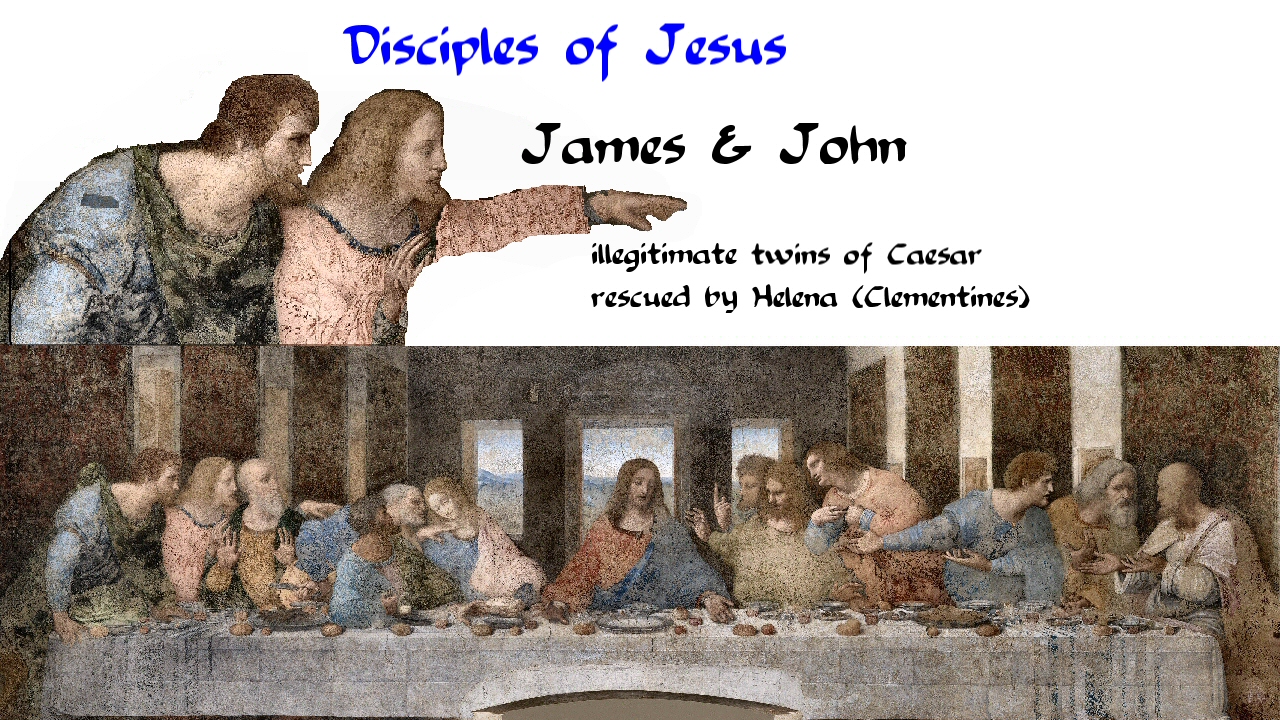
James (3) and John (4) almost always occur together and this was because they were twins. Strangely, the Gospel of John does not mention either of them by name.They are called sons of Zebedee and Zebedee turns out to be Simon Magus by reference to 'The Clementines'. Their histories can be found in the Clementine Recognitions & Homilies. In these differently derived works which are shunned by the Church, their full names are James Niceta and John Aquila, illegitimate children related to the Emperors of Rome. Probably the result of the affair between Augustus Caesar's daughter: Julia the Elder and the son of Mark Antony:Iullus Antonius. They were adopted by Helena, the mother of Mary Magdalene. It was Helena that was was being stoned when Jesus intervened as she was originally a Temple Virgin until found with child. Helena was rescued by Simon Magus and considered to be his consort though both were celibate. She was Martha. Thus he was their step-father Zebedee. John Aquila name is revealed in Acts 18:2,3"And he (Paul) found a Jew named Aquila, a native of Pontus having recently come from Italy with his wife Priscilla, because Claudius had commanded all the Jews to leave Rome. He came to them, and because he was of the same trade he stayed with them, and they worked together, for they were tent-makers by trade." 'Tent-maker' means forming churches, thus confirming "The Clementines". John Aquila and his wife Priscilla were chaperones at Paul's marriage to Jesus' daughter Tamar-Phoebe. Their younger brother Clement was the first Pope after Peter.
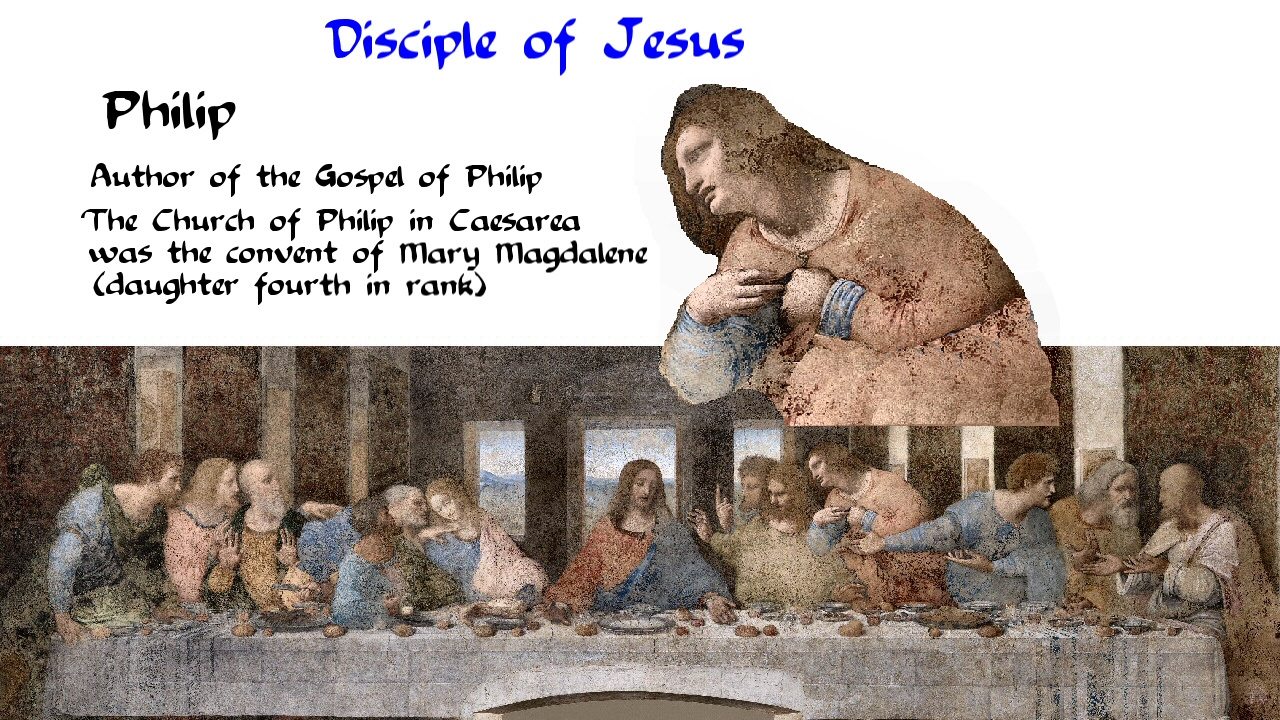
Finally, there is Philip (5) whose claim to fame is the "Gospel of Philip" which implies that Mary Magdalene and Jesus were married. He is also mentioned as having "four unmarried daughters, who prophesied" (Acts 21:8-9). One of these was Mary Magdalene, having left Jesus in the Schism of the Churches along with John Mark, who returned later after her death in 58 AD. She of course knew the true story that Papias told (Eusebius, Fragments Of Papias, Church History XXXIX 8-10) that Jesus did not die on the cross:
"It is worth while however to add to the words of Papias given above other passages from him, in which he records some other wonderful events likewise, as having come down to him by tradition. That Philip the Apostle resided in Hierapolis with his daughters has been already stated; but how Papias, their contemporary, relates that he had heard a marvellous tale from the daughters of Philip, must be noted here. For he relates that in his time a man rose from the dead, and again he gives another wonderful story about Justus who was surnamed Barsabas, how that he drank a deadly poison, and yet, by the grace of the Lord, suffered no inconvenience. Of this Justus the Book of the Acts records that after the ascension of the Saviour the holy Apostles put him forward with Matthias, and prayed for the (right) choice, in place of the traitor Judas, that should make their number complete. The passage is somewhat as follows; And they put forward two, Joseph, called Barsabas, who was surnamed Justus, and Matthias."
This last statement shows that the replacement of Judas was between Jesus' brothers: James (Joseph Barsabas) and Mattias who will be shown to be the next brother in line: Joses.
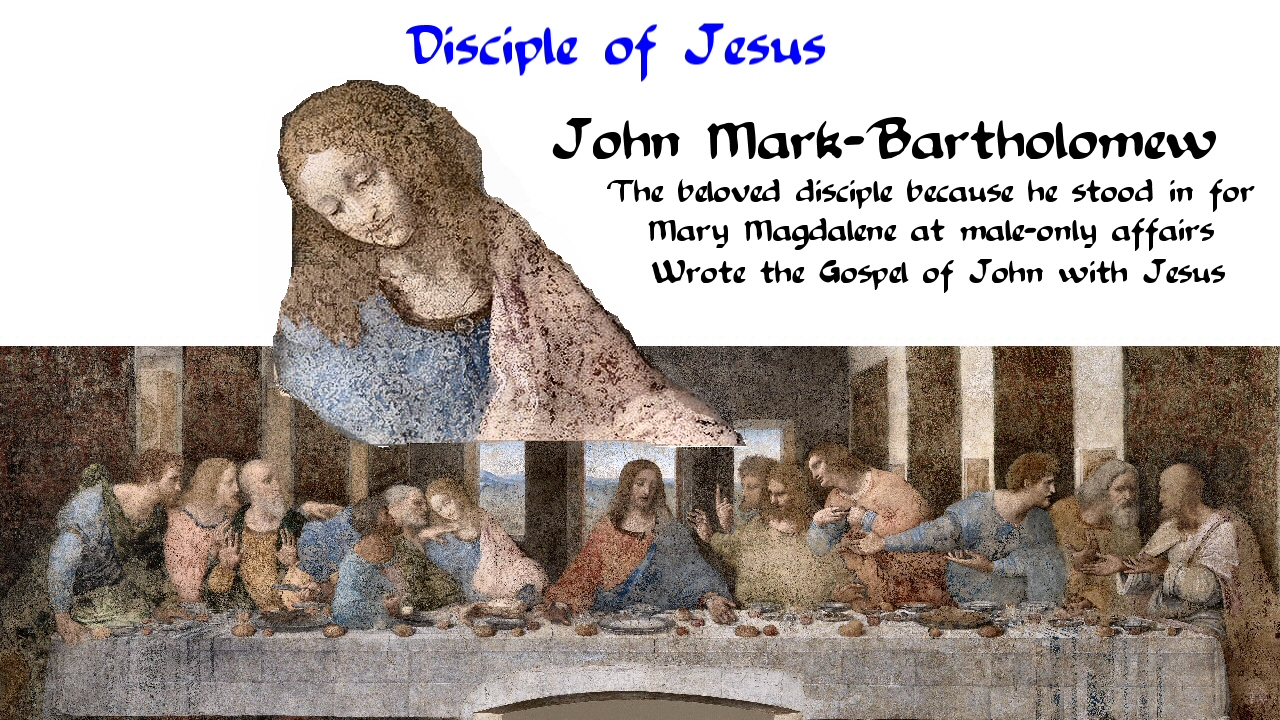
The derivation of Bartholomew (6) has a "bar" on front of that name makes him "son of Tholomew" which is clearly "son of Ptolemy" which places him from Alexandria, Egypt. He can be associated with Eutychus The Centurion's Servant (similar to the Nobleman's son in the John: Healing from a distance.) being a freedman of Herod Agrippa was probably originally from Egypt. In the Works of Philo Judaeus "On The Contemplative Life" section III, Philo talks about Therapeuts (Therapeutae) from Alexandria who practiced the art of healing. He was the stand-in for Jesus at male affairs like the Last Supper, so he was the object of his affection to Mary Magdalene, thus "the disciple that Jesus' loved" (John 13:23). Clearly, the charge that Jesus gave to the "disciple who he loved", which he spoke from the cross, to look after Mary Magdalene, the mother of his child in the womb in John 19:26,27 was followed. He also watched over Mother Mary in Ephesus.
Bartholomew's real name appears in Acts 12:12 "John, who is surnamed Mark"; his further identity as Eutychus is in the story in Acts 20:7-12 who fell down and was brought back to life by Paul (a metaphor for his return to the Faith) which also connects him as (Josephus, Antiquities 18, 4.10Eutychus as the charioteer of Agrippa who informed on Agrippa by over hearing his comments with Nero against Claudius that sent Herod Agrippa to prison.
There is certainly confusion in Church History about two Johns. The John on Patmos who wrote the first part Revelation is John the brother of James. The later John is his son from John Aquila and Priscilla. In Acts as John Mark, he accompanies Barnabas and Paul on their first missionary journey, When Mary Magdalene divorced Jesus, John Mark as her guardian left with her, but returned after her death.
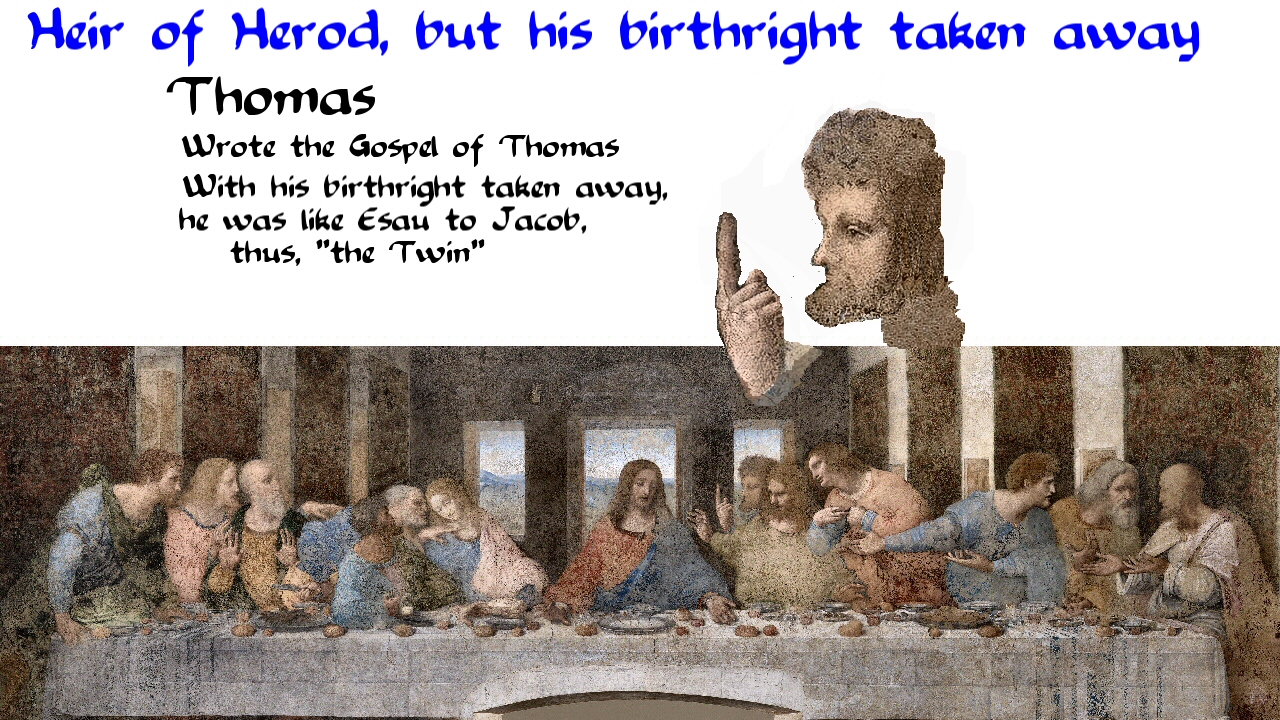
(7) Thomas is well-known, being the "doubting Thomas" and having the Gospel of Thomas and the Acts of Thomas, but his identity is very intriguing. In the Gospel of John he is called 'Didymus' meaning twin. This is a Biblical reference to Esau and Jacob where Jacob stole Esau's inheritance. Also 'Rufus son (subordinate) of Simon (Magus)' Mark 15:21 since Esau had red hair. Herod the Great had promised the kingship to Thomas, but when his mother was implicated in a plot to kill Herod, he was dispossessed. (Josephus, Antiquities 17, 77-78, Josephus, Wars 1, 600). He is referred by Josephus as Herod. Another Herod called Antipas persuaded Herod-Thomas' wife to marry him which meant that Herod Antipas divorced his wife which started a small war (Josephus, Antiquities 18: 109-115). More importantly for Christianity, it led to the death of John the Baptist who opposed the marriage. (Mark 6:17-29 note: Herodias is incorrectly called another Herod Philip's wife). Salome who danced for Herod was actually Thomas's daughter. He was important to Jesus because he actually did not mind about losing his wife because he was homosexual and therefore was still on good terms with Antipas Herod, who was the ruler of Galilee.
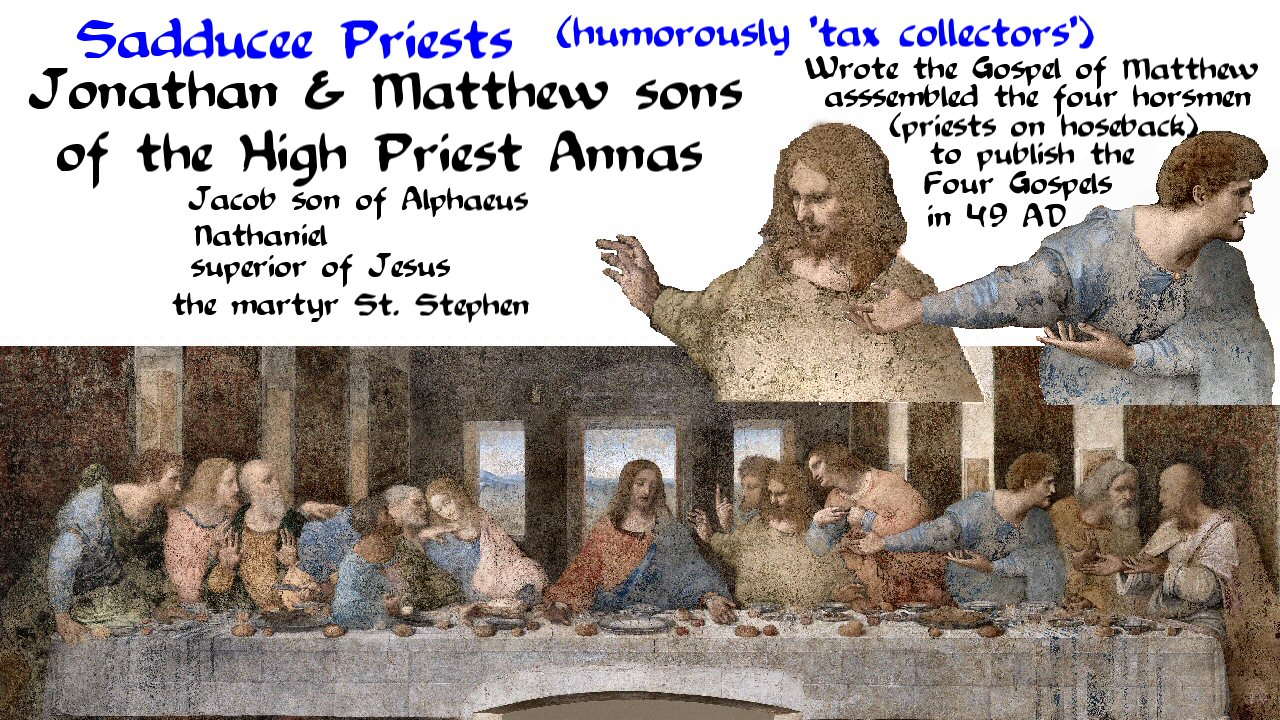
Since James son of Alphaeus does not appear in the Gospel of John and neither does Bartholomew and in fact neither do James and John by name, scholars are confused, not knowing whether to assign him with James brother of John or James the brother of Jesus. Actually it is neither. The clue in deciphering who he is is that he is reporting to an Alphaeus person. By the first part being the Greek letter ‘alpha’ must refer to the “top guy”. In fact Alphaeus is standing for Annas the High Priest. (See Annas High Priests of the New Testament with references from Josephus)
| Annas is father of five high priests and of a daughter married to Caiaphas (the high priest who sent Jesus to be crucified) |
|---|
|
With (9) "James son of Alphaeus" not present in the Gospel of John the "Nathanael" appearing fourth in the Gospel of John, he would be a good candidate for James son of Alphaeus:
John 1:43-51 &
John 21:2 .Comparing this to the
Gospel of Peter verse 60 the comparison of 'Levi the son of Alphaeus' shows the connection to 'Nathanael': "But we, the twelve disciples of the Lord, mourned and were grieved : and each one, being grieved for that which was come to pass, departed to his home. But I, Simon Peter and Andrew my brother, took our nets and went to the sea ; and there was with us (9) Levi the son of Alphaeus ..."
But there is an even more important connection and that is that the name Nathanael means “God has given” which is similar to Jonathan “gift of God”. Jonathan was the son of Saul, king of Israel, of the tribe of Benjamin. Some scholars say that Jonathan was a homosexual and had a crush on David. Given that that Jonathan was the prince, son of King Saul, and David took his title by marrying his sister, this tells us quite a bit about the relationship of “James son of Alphaeus” to Jesus who was in the lineage of David. It would also explain why he was later called “Stephanos” meaning crown making him that same Stephen who was martyred.
In the list of disciples in Matthew, (8) Matthew is said to be a tax collector and since he wrote that Gospel, it is clear that he is in on the joke. Actually the Sadducee priests collected taxes which were collected as church tithes. (Hebrews 7:5): "And those descendants of Levi who receive the priestly office have a commandment in the law to take tithes from the people, that is, from their brothers, though these also are descended from Abraham." This is again an example of an obvious explanation of tax collector overlooked by experts that makes Matthew (Levi), not a forgiven hated tax collector of the Romans, but a tax collector of the Church and in fact a priest of the priestly tribe of Levi.) The Levi in Mark 2:14 & Luke 5:27 is Jonathan Annas as, Levi, son of Alphaeus, a tax collector and a publican who was called to follow Jesus.
Reference lists of Levi (James son of Alphaeus) and Matthew (Matthew the tax collector) from Gospels:
Mark 2:14 "And as he passed by, he saw Levi the son of Alphaeus sitting at the receipt of custom, and said unto him, Follow me. And he arose and followed him."
Luke 5:27 "And after these things he went forth, and saw a publican, named Levi, sitting at the receipt of custom: and he said unto him, Follow me."
Luke 5:29 "And Levi made him a great feast in his own house: and there was a great company of publicans and of others that sat down with them."
Matthew 9:9 "And as Jesus passed forth from thence, he saw a man, named Matthew, sitting at the receipt of custom: and he said unto him, Follow me. And he arose, and followed him."
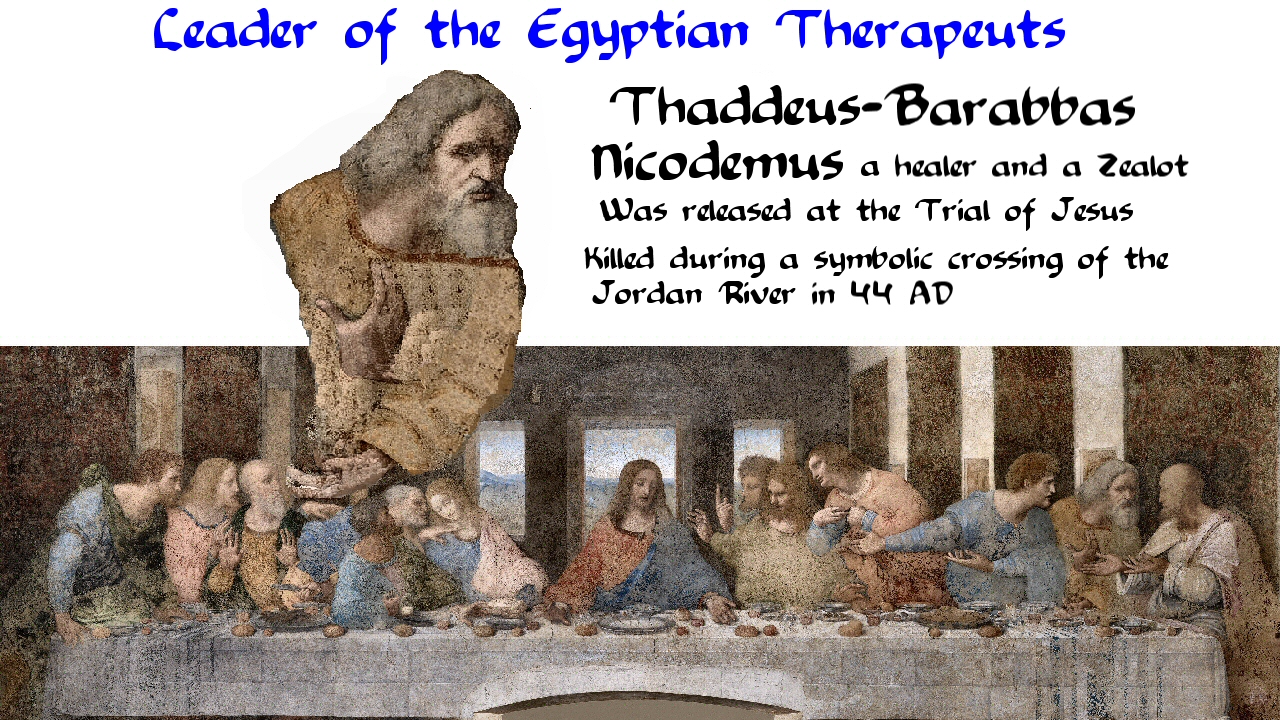
(10) Theudas was the military leader of the Therapeuts.who fought with Judas the Galilean in the Zealot revolt of 6AD. This is the reason for his many names as a wanted criminal. His name Sadduc (Zadoc), the Pharisee is shown in Josephus, Antiquities 18_i_1 The name "Zadoc" is associated with the first high priest in Solomon's temple, indicating that he was a Zealot priest.) He is also called Thaddaeus or Lebbaeus whose surname was Thaddaeus. By comparison to the disciple lists "Judas son of James" was equated to Thaddaeus and it makes sense that his superior would be James as James son of Alphaeus Jonathan Annas (Nathanael) the son of the High Priest Annas. As Nicodemus (meaning 'victory for the people', he questioned Jesus and used his healing arts as a Therapeut to purge the poison that was given to him on the cross. The purpose of the poison was to make Jesus appear to be dead, so that he could be taken down from the cross. Under the name of Barabbas (son of the Abbot) the war hero was considered too old to be up on the cross so Jesus was substituted. (Note that like Simon Bar-Kokhba the zealot similar "bar" in his name.)
Thaddaeus was a subordinate of Simon Magus in verse Mark 15:21 "And they impress a certain one passing by -- Simon, a Cyrenian, coming from the field, the father of Alexander and Rufus -- that he may bear his cross,", thus Alexander is Theudas, head of the Therapeuts of Alexandria and Rufus is Thomas (Esau had a red hair)
In Josephus, Antiquities 20, 97-98, he met his end at a symbolic crossing of the River Jordan:
"During the period when Fadus was procurator of Judea, a certain impostor named Theudas persuaded the majority of the masses to take up their possessions and to follow him to the Jordan river. He stated that he was a prophet and that at his command the river would be parted and would provide them an easy passage. With this talk he deceived many. Fadus, however, did not permit them to reap the fruit of their folly, but sent against them a squadron of cavalry. These fell upon them unexpectedly, slew many of them and took many prisoners. Theudas himself was captured, whereupon they cut off his head and brought it to Jerusalem."
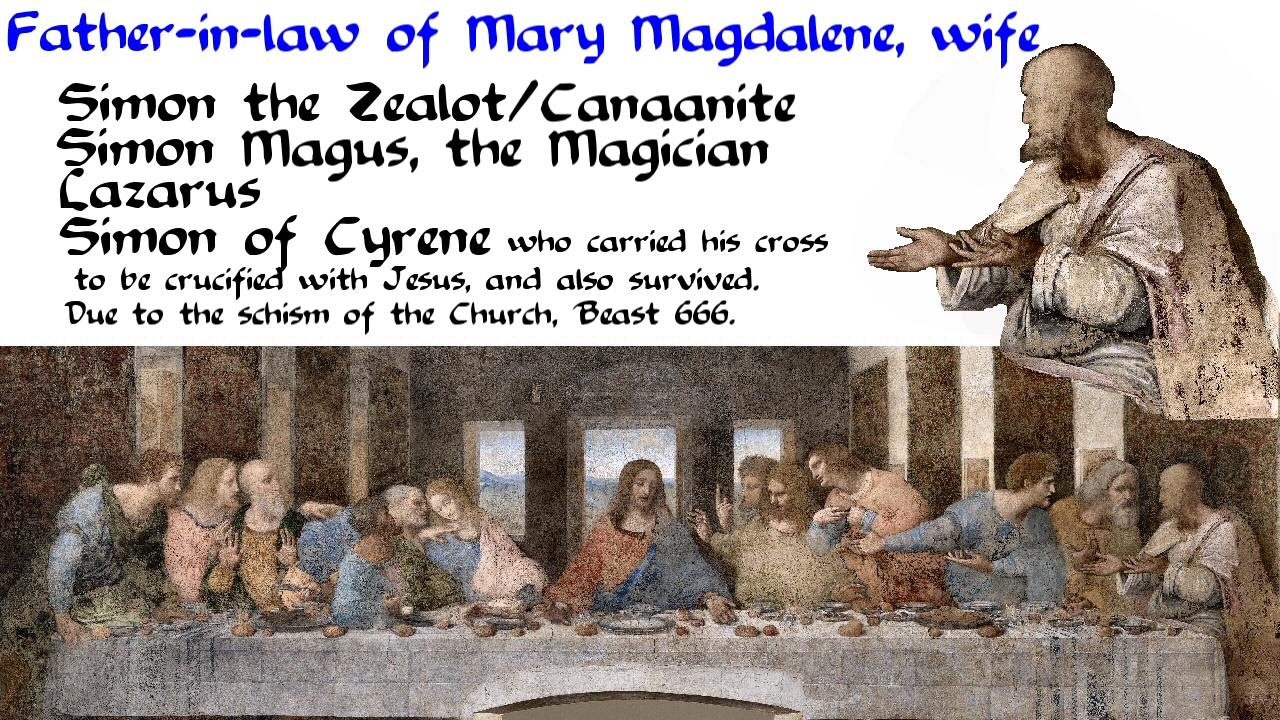
(11) Simon is hardly mentioned in the Gospels. In the disciple list he is a Canaanite in Matthew and a Zealot in Luke and Acts which equates him with Theudas and Judas. In Acts 8:9 his identity is revealed: "But there was a man named Simon who had previously practiced magic in the city and amazed the nation of Samaria, saying that he himself was somebody great." From this he is called Simon Magus.
Once his disguises are removed, he many references not only from The Clementines, The Acts of Peter, and Eusebius of Caesarea who chronicled the first three centuries of Christianity) but as follows:
Zebedee ( Matthew 4:21 , Mark 1:19-20, Luke 5:8-10) because Helena, his consort,
had adopted James and John
Simon of Cyrene ( Matthew 27:32, Mark15:21, Luke 23:26) carrying the cross for Jesus
Lazarus ( John 11:1-44, John 12:1-10, Luke 16:20-23)
Simon the leper ( Matthew 26:6, Mark 14:3)
Simon the tanner ( Acts 9:43, Acts 10:6)
Ananias ( Acts 5:1-5, Acts 9:10-17, Josephus, Ant_20_ii_3)
“the great power of God” ( Acts 8:10, "Acts of Peter", Eusebius, Eccl.Hist. 2, I, 11
Demetrius, the silversmith (Acts 19:24)
Beast 666 (Revelation 13:18)
The discussion of Simon Magus in too large to discuss here, but here are references show that Simon, Lazarus (Simon raised from the dead),
and Simon the Leper (Simon unclean) were all the same Simon Magus and it was his house.
Both Martha and Mary were there:
Luke 7:36 "Now one of the Pharisees invited Jesus to have dinner with him, so he went to the Pharisee's house and reclined at the table." ...
Luke 7:40 "And Jesus answering said unto him, 'Simon, I have something to say to thee;' and he said, 'Teacher, say on.'" ...
Luke 7:43
"And Simon answering said, `I suppose that to whom he forgave the more;' and he said to him, `Rightly thou did judge.'"
Luke 7:44
"And he turned to the woman, and said unto 'Simon, See you this woman? I entered into thine house, you gave me no water for my feet: but she has washed my feet with tears, and wiped them with the hairs of her head.'"
John 11:1,2 "Now a certain man was sick, named Lazarus, of Bethany the town of Mary (Magdalene) and Martha, her sister. (It was that Mary who anointed the Lord with ointment and wiped his feet with her hair, whose brother Lazarus was sick.)."
John 12:1 "Six days before the Passover, Jesus came to Bethany, where Lazarus lived, whom Jesus had raised from the dead."
John 12:2 "There they made him a supper; and Martha served: but Lazarus was one of them that sat at the table with him."
John 12:3 "Then took Mary a pound of ointment of spikenard, very costly, and anointed the feet of Jesus, and wiped his feet with her hair: and the house was filled with the odor of the ointment"
Matthew 26:6 "Now when Jesus was in Bethany, in the house of Simon the leper, there came unto him a woman having an alabaster box of very precious ointment, and poured it on his head, as he sat at meat."
Mark 14:3 "And he, being in Bethany, in the house of Simon the leper, at his reclining (at meat), there came a woman having an alabaster box of ointment,"
There is an engaging story in the Clementine Books and the Acts of Peter that show that Simon is Peter's nemesis with Peter chasing him from town and trying to out- speech him and out-magic him, Finally in the "Acts of Peter" Peter causes Simon to fall during one of his flying magic acts on a high wire. This is commemorated by a plaque in the:


It seems more than a coincidence that Gnostic work “The Second Treatise of the Great Seth” claims that Simon was on the cross instead of Jesus and that Jesus surived: . "Yes, they saw me; they punished me. It was another, their father, who drank the gall and the vinegar; it was not I. They struck me with the reed; it was another, Simon, who bore the cross on his shoulder. I was another upon whom they placed the crown of thorns. But I was rejoicing in the height over all the wealth of the archons and the offspring of their error, of their empty glory. And I was laughing at their ignorance."
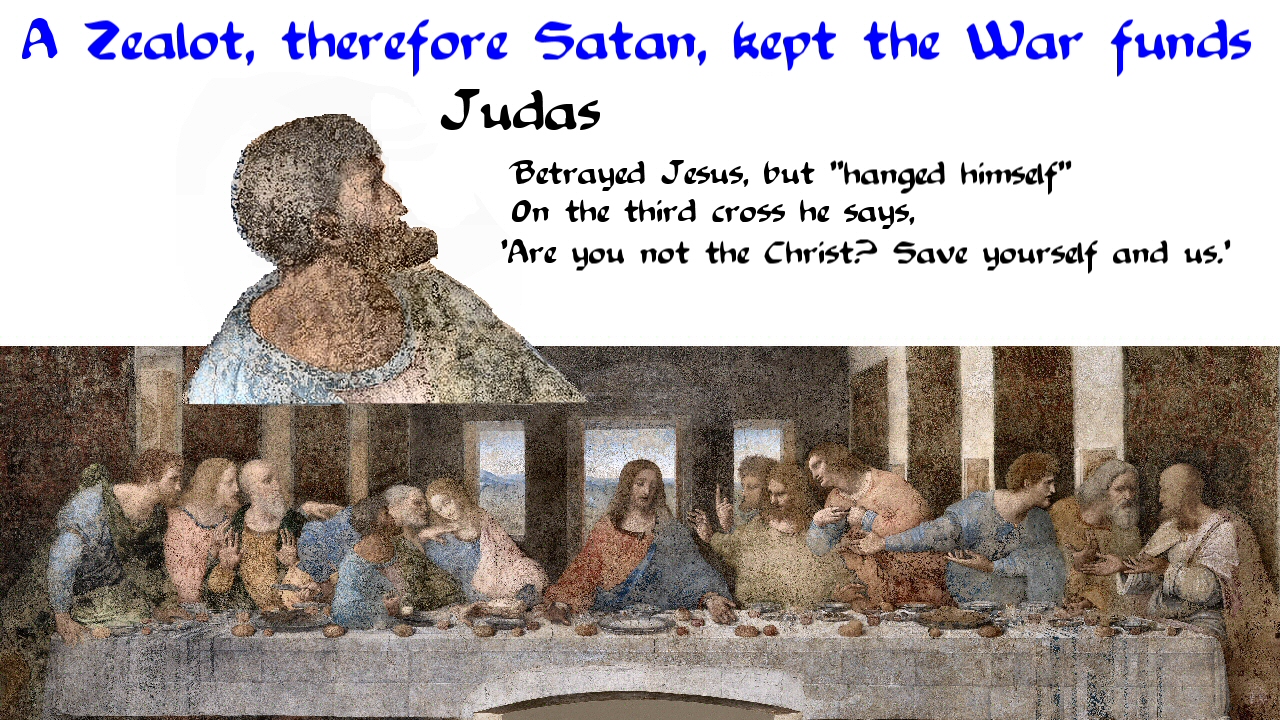
(12) Judas certainly needs no introduction except to note the the description of him hanging himself for 30 pieces of silver (Matthew 27:3-10) is not exactly correct. What is meant is that his betrayal did not save him from the cross. He was on the cross with Jesus and Simon as "One of the criminals who were hanged railed at him" Luke 23:39 "saying, 'Are you not the Christ? Save yourself and us!'". He survived with Jesus and Simon but was hurled out of the burial cave as a traitor: (Acts 1:16-20).
The Iscariot part of Judas's name, sounds like "Sicarii, the name given by the historian Josephus who described a group of Zealots who would hide curved daggers in their cloaks to assassinate people by hiding in crowds.